
Article: The Needlepoint Mental Health Connection
The Needlepoint Mental Health Connection
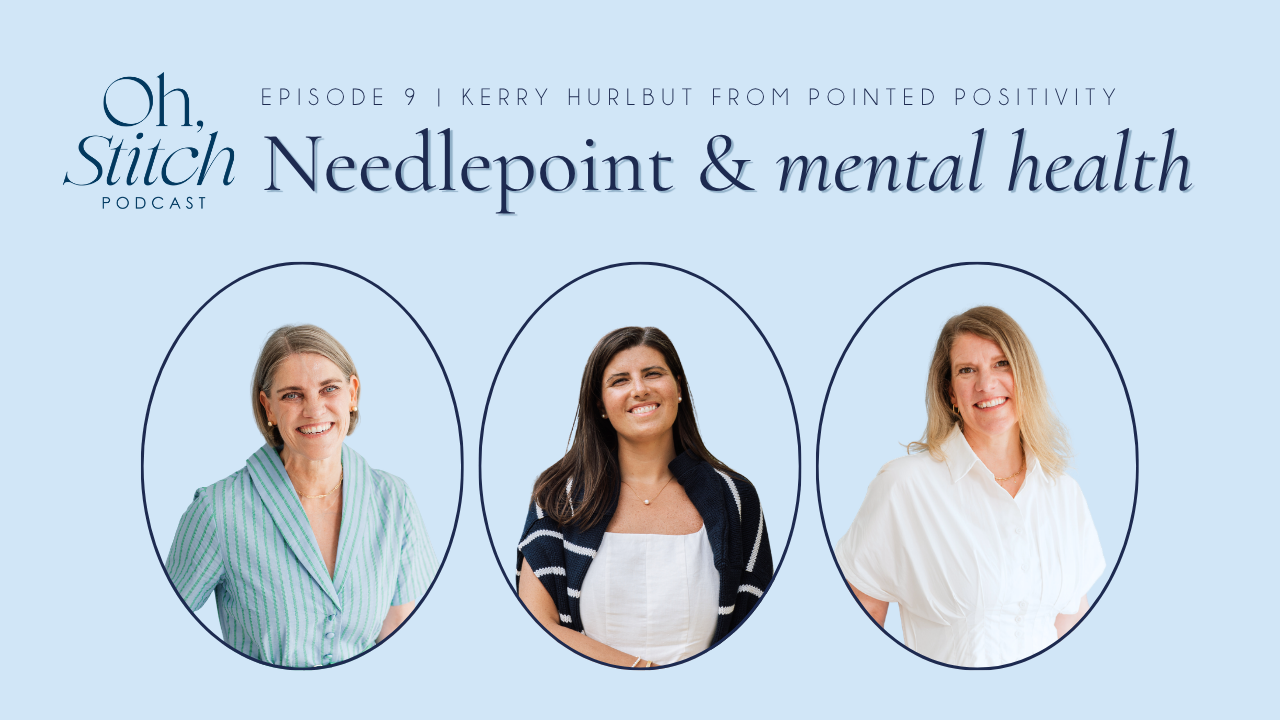
There is a version of self care that involves candles and bubble baths, and there is a version that involves a needle, some thread, and forty five minutes of basketweave until your brain finally stops shouting. On this episode of Oh, Stitch, Natasha and Alonsa sit down with Kerry Hurlbut, a pediatric nurse practitioner and the founder of Pointed Positivity, to talk about the second kind.
Kerry's needlepoint story started in college, thanks to a cross stitching friend from Villanova who nudged her toward the craft. Cross stitch never quite took, but needlepoint did. It carried her through a new job, graduate school, a new relationship and a wedding, and eventually through her own struggles with chronic illness and mental health. Somewhere along the way, it stopped being just a hobby and became something closer to a coping tool, one she now recommends to the families she works with as a rheumatology nurse practitioner.
The Doom Scroll Vs. the Stitch
Kerry's experience as a nurse practitioner is what makes this chat different than your average hobby chat. She works with a lot of teenagers, and she’s watched anxiety and doom scrolling tangle together in a way that leaves their brains with no real off switch. Her explanation for why needlepoint helps is refreshingly simple: doom scrolling floods your body with new stimuli every fifteen to thirty seconds, which keeps your nervous system locked in fight or flight. Needlepoint does the opposite. The repetitive, rhythmic motion nudges you into rest and digest mode instead.
That repetition is doing more work than it looks like. Kerry pointed to research comparing needlework to EMDR therapy, a treatment often used for trauma and PTSD, because both rely on rhythmic, bilateral movement to calm the brain. And there is a reason your hands specifically matter so much here. A huge portion of your brain's real estate is devoted to processing sensation in your hands, far more than somewhere like your abdomen. That is why a paper cut can nag at you all day while you barely notice a stomach ache. Put your hands to work with something rhythmic and repetitive, and you are lighting up the exact parts of the brain tied to emotional regulation.
Pointed Positivity Origin Story
Kerry's own turning point came during a season when her mental health took a real hit. A new job, a wedding, family stress, and some health struggles of her own collided all at once, and she stepped away from work to focus on recovery. During that time, she was needlepointing almost every day, and she started to notice how much that stitching was carrying her.
Being a nurse practitioner, she needed to know why. So she went looking for the research on creative hobbies and well being, and found an article called Healing Stitches that broke down the benefits of needlework in a way that finally gave her language for what she had already felt. That research, plus her own experience with the community that shows up around needlepoint, is what led her to launch Pointed Positivity, a space where she shares stitchers' stories side by side with the evidence behind why the craft works.
The Two Hour Benchmark
If you only take one thing away from this episode, let it be this. Kerry shared a benchmark from the research she has studied: people who engaged with a hobby for less than two hours a week saw no meaningful improvement in their well being scores. People who hit two hours or more did. It does not need to happen in one sitting. Seventeen minutes a night adds up just as well as a long Sunday afternoon. Think of it less as a prescription and more as a gentle nudge, a reason to make room for the thing that makes you feel like yourself again.
Advice for New Stitchers
Kerry's best advice for anyone just getting started echoes something you will hear a lot on this show: pick a project you actually love, not just one labeled "beginner." You are far more likely to finish something that means something to you. And whatever you choose, kit it in full before you leave the shop. Trying to piece together threads at home later is a special kind of overwhelm nobody needs.
Show Links
Decorative Stitch Playlist: A FREE video playlist of decorative stitches.
Special Offer: Use code OHSTITCH10 for 10% off your first order at georgieandlottie.com.
Connect with Kerry:
Website: pointedpositivity.com
Instagram: instagram.com/pointedpositivity
TikTok: tiktok.com/@pointedpositivity